The first time I fermented sauerkraut, I used a regular mason jar lid screwed on loosely. The idea was that gas would escape through the gap. It did, sometimes. Other times, pressure built up until the lid popped with enough force to spray brine across the counter. The ferment turned out fine. My kitchen wall needed wiping down.
Airlock lids solve this by letting carbon dioxide escape without letting oxygen or airborne contaminants in. They are a one-way valve for your fermentation jar. The concept is borrowed from homebrewing, where airlocks have been standard equipment for decades, and the adaptation to mason jar fermentation has produced several distinct designs worth understanding.
How airlock lids work
During lacto-fermentation, bacteria convert sugars into lactic acid and carbon dioxide. That CO2 needs to go somewhere. In an airtight container, pressure builds. In a loosely covered one, oxygen gets in and invites mold. An airlock sits in the middle: it lets gas out through a water trap or silicone valve while blocking air from entering.
The practical result is fewer surface mold issues, less babysitting (no burping jars multiple times a day), and more consistent fermentation environments. For beginners especially, airlock lids remove a variable that can ruin a first batch and discourage the whole hobby.
Three-piece water-trap airlocks
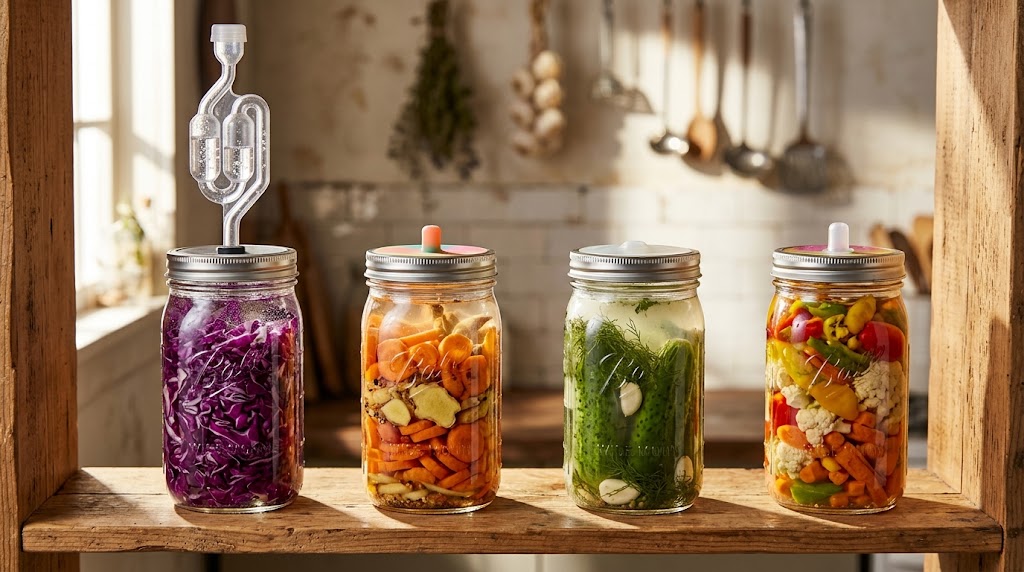
The traditional homebrewing airlock is a small S-shaped or three-piece plastic tube that you fill with water. Gas bubbles through the water and escapes; air cannot travel back through the water barrier. These are the cheapest option and have decades of proven use in beer and wine making.
For mason jar fermentation, companies sell lids with a grommet hole that accepts a standard airlock. The Fermentology airlock lid kit includes wide-mouth lids with pre-drilled holes and three-piece airlocks that snap in. You fill the airlock chamber with water, screw the lid on, and the system handles gas release automatically.
The downside is height. A three-piece airlock adds 10 to 12 cm above the jar lid, which can be awkward in a fridge or on a shelf with limited clearance. The water in the airlock can also evaporate during long ferments (more than two weeks), so you need to check and top it up occasionally.
Silicone valve lids
Silicone valve lids are the newer, lower-profile alternative. Instead of a water trap, they use a small silicone flap or slit that opens under internal pressure and seals shut when pressure equalises. No water needed, no tall airlock sticking up, and they fit in the fridge without clearance issues.
The Masontops Pickle Pipes are probably the most recognisable version. They are one-piece silicone discs that sit inside a wide-mouth mason jar band. The centre has a slit valve. Gas pushes the slit open; once pressure drops, the silicone seals back. Simple, effective, and dishwasher-safe.
The trade-off is that silicone valves do not provide a visual indicator that fermentation is active. With a water airlock, you see bubbles. With a silicone valve, you have to look for other signs (brine cloudiness, vegetable colour change, lid bulging slightly). For experienced fermenters, this is fine. For first-timers, the visible bubbling of a water airlock provides useful reassurance.
Stainless steel lids with built-in valves
Some manufacturers combine a stainless steel lid body with a silicone or rubber valve. These look more polished than plastic airlocks and are more durable than all-silicone lids. They tend to cost more but last essentially forever.
The County Line Kitchen fermentation lids use a stainless steel base with a silicone valve and include a built-in handle for easy removal. They fit wide-mouth jars, resist staining from turmeric-heavy ferments, and the stainless body does not absorb odours the way all-silicone lids can over time.
Wide-mouth vs regular-mouth
Nearly all fermentation airlock lids are designed for wide-mouth mason jars. This is not arbitrary. Wide-mouth jars are easier to pack vegetables into, easier to insert and remove fermentation weights, and easier to clean. If you are using regular-mouth jars, your airlock options shrink dramatically.
The practical recommendation: if you do not already own wide-mouth jars, buy them. A case of twelve wide-mouth quart jars costs roughly the same as two specialty fermentation airlock lids, and they are useful for canning, storage, and meal prep beyond fermentation.
Do you actually need airlock lids?
Plenty of fermenters use nothing more than a mason jar with a regular lid set loosely on top, or a piece of cloth secured with a rubber band. These methods work. Sauerkraut and kimchi have been made for centuries without specialised lids.
What airlock lids do is reduce the failure rate, especially for beginners. They remove the need to burp jars, reduce surface mold issues, and create more consistent results. If you are making one jar of sauerkraut per month, a loose lid is fine. If you are running three or four ferments at once and do not want to babysit them, airlock lids earn their keep quickly.
FAQ
Can I reuse airlock lids?
Yes. All types are reusable. Silicone lids and stainless steel lids last indefinitely with proper cleaning. Plastic water-trap airlocks may need replacing every year or two as the plastic becomes brittle.
Will airlock lids fit any brand of mason jar?
Wide-mouth airlock lids fit any standard wide-mouth mason jar (Ball, Kerr, Bernardin, and most generic brands use the same thread pattern). Regular-mouth lids are less universally compatible; check the product listing for your jar brand.
How long does the water in a water-trap airlock last?
In a cool environment, two to three weeks before you need to top it up. In a warm room, check weekly. If the water evaporates completely, the airlock stops working as a one-way valve.
As an Amazon Associate, I earn from qualifying purchases. Product links on this page may earn Culture & Crumb a small commission at no extra cost to you.