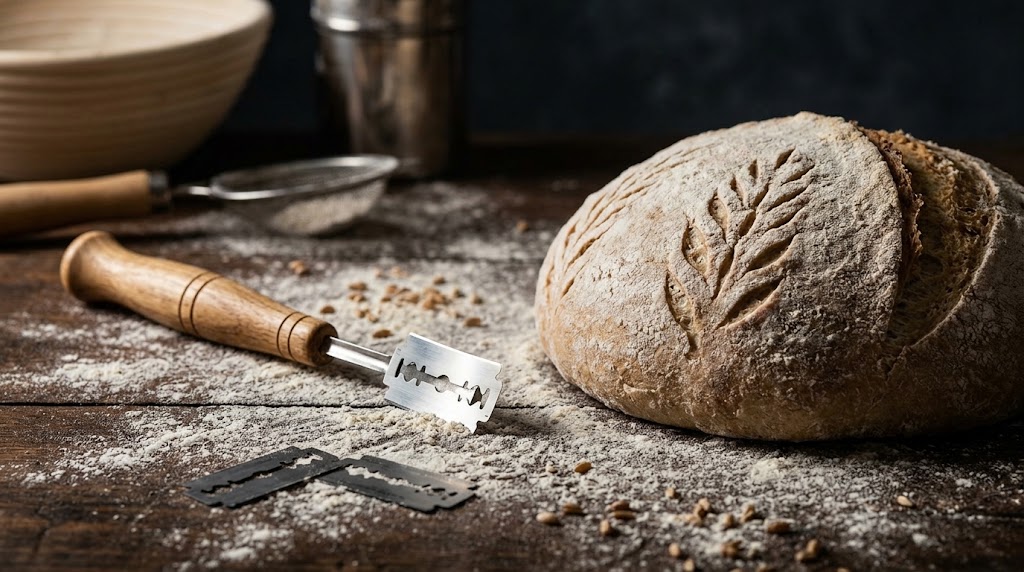
Scoring is the last thing you do before the loaf goes into the oven, and it is the one step where a bad tool makes the biggest visible difference. A dull knife drags through the dough surface, tears it, and produces a ragged opening that bakes into something that looks accidental. A sharp lame glides through and leaves a clean line that opens predictably as the bread expands.
The cut itself is functional. It controls where steam escapes and where the loaf expands. Without a score, the bread finds its own weak point and bursts unpredictably, often along the bottom or at a seam. With a well-placed score, the loaf opens where you intend it to, creating the "ear" that is one of the visual signatures of good sourdough.
What a bread lame actually is
A lame (pronounced "lahm") is a handle that holds a razor blade at an angle. That is the whole product. The blade is typically a standard double-edge safety razor blade, the kind used in old-fashioned shaving razors. The handle provides control and keeps your fingers away from the cutting edge.
The angle matters. A straight blade (perpendicular to the handle) cuts vertical slashes. A curved blade (bowed slightly by the tension of the handle) cuts at an angle that creates an ear, the flap of dough that lifts away from the loaf surface during baking. Most sourdough bakers want the curved option for boules and the straight option for decorative patterns.
Fixed-blade lames
Fixed-blade lames hold the razor blade in a permanently curved position. The Wire Monkey UFO lame is the most talked-about option in the sourdough community. It uses a wire frame that bows the razor blade into a consistent arc. The curve is optimised for creating ears on boule-style loaves, and the design keeps the blade tension constant across its entire life.
Fixed-blade lames are simpler to use because the blade angle is set. You do not need to think about how much curve to apply. Pick it up, score, put it down. The consistency is the selling point.
Adjustable and straight lames
Some lames hold the blade flat (straight) or allow you to adjust the curve. The Breadtopia bread lame is a wooden-handled option with a straight blade holder. It works well for cross-hatching, leaf patterns, and any scoring design where you want clean straight lines rather than curved ear-producing cuts.
For bakers who do both decorative scoring and ear-producing slashes, having one of each is practical. A curved lame for the main score and a straight one for decorative work covers every situation.
Replacement blades and sharpness
The blade is the most important variable, not the handle. A fresh razor blade glides through hydrated dough with almost no resistance. A blade that has been used for five or six bakes starts to drag, catching on the dough surface instead of slicing through it.
Replace the blade every three to five bakes for consistent scoring. Double-edge safety razor blades cost very little, usually less than $0.10 each when bought in bulk packs of 50 to 100. The Astra Platinum double-edge blades are a popular choice among bread bakers. They are sharp, consistent, and cheap enough that there is no reason to extend blade life beyond its useful window.
Scoring technique basics
For a basic ear-producing score on a round boule:
- Hold the curved lame at about 30 degrees to the dough surface
- Start the cut about one-third of the way from the edge, not at the centre
- Move the blade in one swift, confident motion. Hesitation causes dragging
- Cut about 6 to 8mm deep. Too shallow and the ear will not lift; too deep and the loaf weakens structurally
For batards (oval loaves), a single long slash down the centre at a slight angle is the classic score. For decorative patterns, shallow cuts (3 to 4mm) with a straight blade create designs that open gently without producing dramatic ears.
Kitchen scissors as an alternative
Some bakers skip the lame entirely and use sharp kitchen scissors (shears) for scoring. Scissors work well for certain patterns: snipping the surface at angles creates wheat-stalk designs that are hard to achieve with a flat blade. They also work better than lames on very wet, sticky doughs that cling to razor blades.
Scissors are not a replacement for a lame in all situations. They cannot produce a thin, angled score for a classic ear. But as a supplementary tool for decorative work, they are worth having in the baking drawer.
FAQ
Can I just use a sharp kitchen knife for scoring?
You can, but the thicker blade drags more than a razor and produces less precise cuts. A serrated knife is worse: it tears. If a lame is not available, a single-edge box cutter blade held at an angle is closer to the right tool than a kitchen knife.
Why does my score seal up during baking instead of opening?
Usually one of three reasons: the cut was too shallow, the oven was not hot enough (pre-heat to at least 230 degrees Celsius), or the dough was over-proofed and had exhausted its oven spring. A properly proofed dough with a decisive score will open.
How do I clean a bread lame?
Wipe the blade with a dry cloth after each use. Do not soak it in water. If dough has dried on the blade, a quick wipe with a damp cloth loosens it. Store with the blade covered or removed to avoid accidental cuts.
As an Amazon Associate, I earn from qualifying purchases. Product links on this page may earn Culture & Crumb a small commission at no extra cost to you.