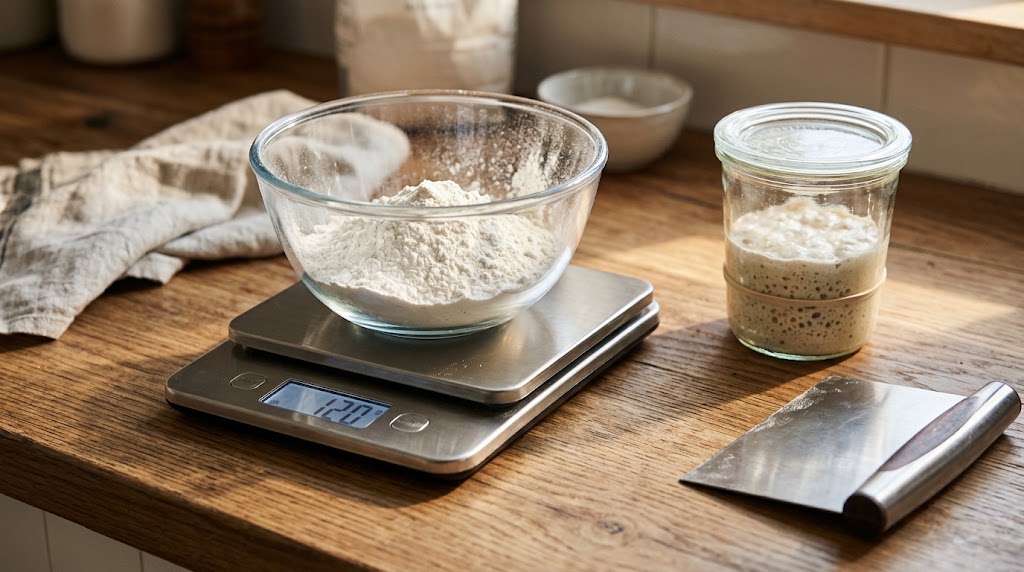
There is a moment in every baker's development where they realise that "one cup of flour" is a fiction. Scoop it from the bag and you might have 120g. Spoon it into the cup and level it and you might have 130g. Use a different brand of flour and the density changes again. Professional bakers do not use cups. They use grams. And the tool that bridges the gap between imprecise measuring and consistent baking is a kitchen scale.
For sourdough in particular, precision matters. Your starter is fed by ratio. Your dough hydration is calculated by weight. Even your salt is measured in grams because a "teaspoon" of fine salt weighs differently from a "teaspoon" of coarse salt. A scale is not an upgrade. It is the baseline.
What to look for in a baking scale
Not every kitchen scale is equally suited to baking. Here is what actually matters:
- Gram precision (1g or 0.1g): A scale that reads in 1g increments covers bread baking and most recipes. For sourdough starter maintenance where you are measuring 10g to 50g of flour and water, 1g resolution is fine. For spice work or micro-yeast measurements, 0.1g resolution is better but costs more.
- Capacity: At least 5kg. A full batch of bread dough including the bowl can easily weigh 2 to 3kg. Scales capped at 2kg are too small for baking.
- Tare function: Essential. You place the bowl, press tare, add flour, press tare, add water, and so on. Every baking scale has this. Some are faster to respond than others.
- Auto-off timeout: This is the feature that separates a good baking scale from a frustrating one. Many kitchen scales shut off after 60 to 90 seconds of inactivity. During an autolyse or a long mixing session, the scale goes dark mid-weigh. Look for scales with extended auto-off (5 minutes or more) or a manual-off setting.
Budget picks: under $20
The Etekcity food kitchen scale is the default recommendation in this price range. It reads to 1g, handles up to 5kg, tares quickly, and runs on two AAA batteries. It is thin enough to slide into a drawer and durable enough to handle daily use. Thousands of bakers use this exact scale, and it works.
At this price, you give up a few things: the auto-off is about two minutes (manageable but occasionally annoying), the platform is not large enough for very wide bowls, and there is no 0.1g mode. For straightforward bread baking, none of those limitations matter.
Mid-range: $20 to $50
Stepping up in price gets you better build quality, longer auto-off times, and sometimes dual precision modes.
The OXO Good Grips scale with pull-out display solves the bowl-covers-the-screen problem with a display that pulls out from under the platform on an arm. When a large mixing bowl sits on the scale, you can still read the weight. This sounds like a minor feature until the first time you cannot see the display under your dough bowl and have to lift the bowl to check.
The My Weigh KD-8000 is the enthusiast choice. It offers baker's percentage mode (you set the flour weight as 100% and it calculates other ingredients as percentages), an 8kg capacity, and an auto-off that you can extend up to five minutes. It is bulkier and not as sleek as the OXO, but the baker's percentage function alone makes it worth considering for anyone who bakes frequently.
Do you need 0.1g precision?
For bread baking, no. The difference between 500g and 500.3g of flour is undetectable in the final loaf. Where 0.1g precision matters is in small-quantity measurements: instant yeast (sometimes used in tiny amounts alongside sourdough for timing control), spices, and sourdough starter feeds when maintaining a very small starter (5g to 10g maintenance feeds).
If you want 0.1g precision, a small jewellery-style pocket scale ($10 to $15) as a secondary scale works better than buying a single scale that tries to cover both ranges. A 5kg scale with 0.1g precision across the full range is expensive and often inaccurate at the extremes.
Batteries vs rechargeable vs USB
Most kitchen scales run on two AAA or two CR2032 coin batteries. Battery life varies from six months to over a year with regular use. Some newer models offer USB-C rechargeable batteries, which avoids the waste of disposable batteries but means the scale needs charging.
Practically, battery type is a minor consideration. A pair of AAA batteries costs very little and lasts long enough that you will forget about it until they die during a bake (at which point the lesson about keeping spare batteries becomes permanent).
Placement and surface
Kitchen scales are sensitive to surface vibrations and uneven countertops. Place the scale on a flat, stable surface away from the edge of the counter. If your countertop is not perfectly level (many are not), some scales have adjustable feet. Otherwise, a cutting board underneath provides a stable platform.
Do not place a hot pot directly on the scale. Heat damages the strain gauge sensor underneath the platform. Let baked items cool before weighing. If you need to weigh something hot, place a trivet between the hot item and the scale.
FAQ
Why does my scale show different weights when I put the same thing on twice?
This usually means the scale needs recalibrating, the battery is low, or the surface is not level. Most scales have a calibration function in the settings. Check your manual for instructions specific to your model.
Can I weigh liquids on a kitchen scale?
Yes, and you should. One gram of water equals approximately one millilitre, so weighing water is as accurate as using a liquid measuring cup and faster. For other liquids (oil, milk, honey), the density differs slightly from water but the convenience of weighing rather than pouring into a measuring cup still wins.
How do I clean a kitchen scale?
Wipe the platform with a damp cloth. Do not submerge the scale or run water over the display area. For stuck-on dough or flour paste, a slightly damp cloth with a drop of dish soap works. Dry immediately.
As an Amazon Associate, I earn from qualifying purchases. Product links on this page may earn Culture & Crumb a small commission at no extra cost to you.