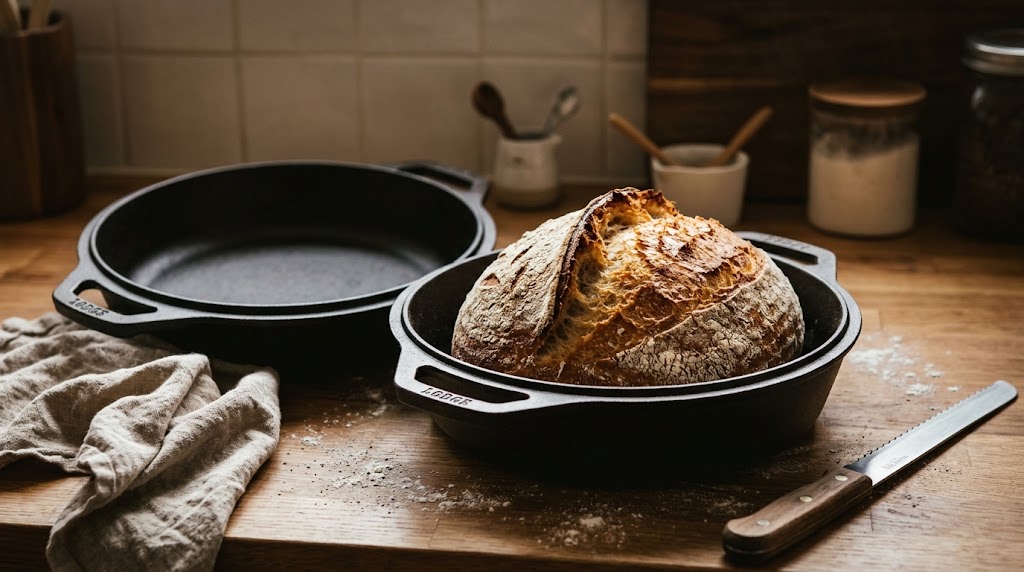
You can bake decent sourdough without a Dutch oven. You can create steam with ice cubes, spray bottles, lava rocks, and wet towels. People do it, and the bread comes out edible. But if you have ever sliced into a loaf baked in a Dutch oven next to one baked on an open rack, the difference is hard to ignore. The crust shatters instead of bends. The ear lifts. The crumb opens more evenly. Steam makes sourdough what it is, and a Dutch oven is the simplest way to trap it.
The question is not whether to bake in a Dutch oven. The question is which one to buy, because the price range runs from under $40 to over $400, and not all of that price difference translates to better bread.
Why a Dutch oven works for sourdough
During the first 15 to 20 minutes of baking, sourdough dough releases steam from its surface. In a commercial bakery, steam injection systems flood the oven chamber with moisture. At home, you do not have that. A Dutch oven with the lid on creates a sealed chamber around the loaf, trapping the moisture the dough itself releases.
That trapped steam keeps the crust soft long enough for the dough to expand fully (oven spring), produces the blistered surface texture, and enables the Maillard reaction that gives sourdough its deep colour. After 20 minutes, you remove the lid and let the crust dry and harden for the remaining bake time.
Lodge cast iron: the workhorse
Lodge has been making cast iron in Tennessee since 1896. Their Dutch ovens are the default recommendation in sourdough forums, and for good reason: they are heavy, retain heat well, and cost a fraction of European brands.
The Lodge combo cooker is the most popular choice among home sourdough bakers. It is technically a deep skillet with a lid, but you flip it: bake on the shallow side (easier to load dough) and cover with the deep side. This design solves the single biggest complaint about traditional Dutch ovens, which is lowering a fragile dough ball into a screaming hot deep pot without burning your forearms.
The Lodge 5-quart Dutch oven is the traditional round option. It fits loaves up to about 900g of dough comfortably. The enamel version (Lodge Enameled) is easier to clean but costs more and the enamel can chip over time at the high temperatures sourdough requires (230 to 260 degrees Celsius).
Le Creuset: the premium choice
Le Creuset's enamelled cast iron Dutch ovens are beautiful kitchen objects. The enamel is smoother and more durable than Lodge's, the heat distribution is marginally more even, and the colour options let you match your kitchen. The 5.5-quart round is the right size for sourdough.
Does the bread taste different? Honestly, no. The baking results are nearly identical to a Lodge at five to eight times the price. What you get with Le Creuset is durability of the enamel coating, a lighter weight per unit volume (their manufacturing process produces slightly thinner walls), and the confidence that the pot will look good on your stovetop for decades.
If you already own a Le Creuset and it fits a sourdough loaf, use it. If you are buying specifically for bread, the premium is hard to justify on baking performance alone.
Staub: the baker's dark horse
Staub occupies a middle ground between Lodge and Le Creuset. Their black matte enamel interior is better suited to high-heat baking than Le Creuset's light enamel, which can stain and discolour over time. The lids also have small spikes on the underside (Staub calls them "self-basting spikes") that theoretically redistribute moisture, though the effect on bread baking is negligible.
The Staub 5.5-quart round cocotte handles the 230 to 260 degree range sourdough needs without the enamel concerns. The darker interior also does not show staining, which matters when you are pre-heating an empty pot to maximum temperature every bake.
Size and shape: round vs oval
For boule-style (round) loaves, a round Dutch oven is the obvious match. The 5 to 5.5 quart size fits loaves made from 500g to 1kg of flour comfortably. Going larger than 6 quarts means the dough spreads sideways instead of rising upward, which defeats the purpose.
Oval Dutch ovens work for batard-shaped (oblong) loaves. If you prefer that shape, a 7-quart oval is roughly equivalent to a 5-quart round in terms of headroom. But oval loaves are harder to score consistently and are more finicky about shaping, so most home bakers start and stay with rounds.
Bare cast iron vs enamel
Bare cast iron (Lodge's standard line) handles extreme heat without any risk of enamel damage. It is cheaper, and seasoning actually improves with bread baking because the high temperatures polymerise oil layers effectively. The downside is maintenance: it needs to stay dry, it can rust if neglected, and acidic foods (not relevant for bread) can strip seasoning.
Enamelled cast iron is easier to clean and does not require seasoning. But enamel has a temperature ceiling. Most manufacturers rate their enamel to 260 degrees Celsius, and some sourdough recipes call for 250 or higher. Sustained use at the enamel's upper limit can cause crazing (fine cracks in the enamel surface) over years.
For bread-only use, bare cast iron wins on practicality and cost. For a pot that also makes stews, braises, and soups, enamel is more versatile.
Budget and value comparison
The difference in bread quality between a $40 Lodge and a $350 Le Creuset is functionally zero. Both trap steam. Both retain heat. Both produce excellent crust.
- Lodge combo cooker ($35 to $45): Best value. Easier dough loading. Works exactly as well as pots costing ten times more.
- Lodge 5-quart ($30 to $40): Traditional round pot. Slightly more awkward to load dough but a solid performer.
- Staub 5.5-quart ($150 to $250): Better enamel for high-heat use. Looks good. Performs identically to Lodge for bread.
- Le Creuset 5.5-quart ($300 to $400): Premium. Beautiful. Bakes the same bread as the Lodge.
FAQ
Can I use a ceramic or clay baker instead of cast iron?
Yes. Emile Henry and Romertopf make clay bakers designed for bread. They work on the same steam-trapping principle. Clay heats more slowly but retains heat well. The risk is thermal shock: never put a cold clay baker in a hot oven or it may crack.
Do I need to oil the Dutch oven before baking bread?
Most bakers use parchment paper to prevent sticking and protect the pot surface. If using bare cast iron without parchment, a light coat of oil or a dusting of cornmeal works. Enamel pots should use parchment to avoid staining.
What if my Dutch oven has a plastic knob on the lid?
Some Le Creuset models come with phenolic (plastic) knobs rated to about 190 degrees Celsius. That is too low for sourdough baking. Replace it with a stainless steel knob (Le Creuset sells them) or an aftermarket metal knob before baking at bread temperatures.
As an Amazon Associate, I earn from qualifying purchases. Product links on this page may earn Culture & Crumb a small commission at no extra cost to you.