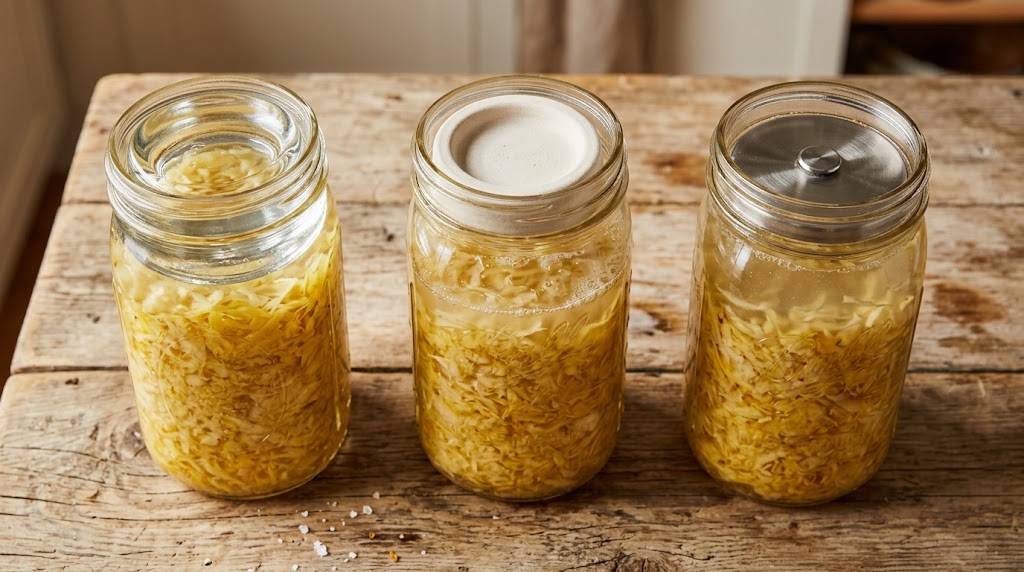
Every guide to lacto-fermentation mentions keeping vegetables submerged. Fewer explain what happens when you fail. The short version: anything above the brine meets oxygen, and oxygen invites mold. The long version involves scraping fuzzy growth off the surface of what was supposed to be your first batch of sauerkraut and wondering whether the rest is still safe.
Fermentation weights exist to solve that one problem. They sit on top of your vegetables, pushing everything below the brine line where the anaerobic environment does its work. Simple in concept. But the material you choose affects how well the weight performs, how long it lasts, and whether it introduces any unwanted flavours.
Glass weights: the clear favourite for jar ferments
Glass fermentation weights are the most popular option for wide-mouth mason jar fermentation, and for good reason. They are non-reactive, easy to clean, and you can see through them to check the brine level without removing the weight.
Most glass weights come sized for wide-mouth jars, typically 70 to 76 mm in diameter. They sit inside the shoulder of the jar and rest directly on the vegetables. Weight varies from about 100g to 200g per piece, which is enough to keep lighter vegetables like shredded cabbage submerged but sometimes not enough for buoyant items like whole peppers or cucumber spears.
The Masontops Pickle Pebbles are a widely recommended option. They are sized precisely for wide-mouth Ball and Kerr jars, have a small handle nub for easy removal, and the borosilicate glass handles temperature changes without cracking. A set of four covers your first few jars.
The downside of glass is fragility. Drop one on a tile floor and you are sweeping up pieces. And for crocks or vessels larger than a standard mason jar, individual glass pebbles do not cover enough surface area.
Ceramic weights: built for crocks
Ceramic fermentation weights are designed for traditional fermentation crocks, the large stoneware vessels with water-seal lids that German and Korean fermenting traditions have used for generations. These weights are typically semi-circular (two halves that fit together to form a full circle) and sized to match the crock's interior diameter.
Ceramic is heavier than glass per unit, which is actually an advantage when fermenting dense vegetables like whole cabbage quarters or large batches of kimchi. The extra mass keeps everything pinned down even as gases build and try to push vegetables upward.
The Ohio Stoneware ceramic weights are made specifically for their fermentation crocks but also fit similarly sized vessels. They are food-safe glazed, heavy enough to handle large batches, and the two-piece design lets you remove one half at a time when checking on a ferment.
Ceramic weights are less versatile than glass. They only fit the crock they were designed for (or one very close in diameter), and the glazed surface can chip if knocked against the crock rim during removal. But for dedicated crock fermenters, they are the traditional and practical choice.
Stainless steel weights: durable and heavy
Stainless steel fermentation weights are the newest option in the category and solve the durability problem. They will not chip, crack, or break if dropped. They are also significantly heavier than glass alternatives of the same size, which makes them better at keeping stubborn vegetables submerged.
The Trellis + Co stainless steel fermentation weights fit wide-mouth mason jars and use a spring-loaded design that grips the inside of the jar. This means they hold themselves in place rather than relying solely on gravity, which is useful for ferments that produce a lot of gas and tend to push lighter weights upward.
The trade-off with stainless steel is cost. They typically run two to three times the price of glass weights. And while 304 and 316 stainless steel are both food-safe, you want to make sure the product specifies one of these grades. Lower-grade stainless can corrode in the acidic brine environment over time.
DIY alternatives and why they fall short
Before spending any money, some fermenters try filling a zip-lock bag with brine and placing it on top of the vegetables. This works in a pinch, but the bag can shift, leak, or develop tiny holes that allow air contact. A small plate with a jar of water on top is another common hack, but it rarely creates an even seal against the vessel walls.
Rocks from the garden are occasionally suggested online. Do not use them. Many natural stones are porous, harbour bacteria, and some types react with acidic brine. The few dollars spent on a proper weight avoids a batch of sauerkraut that tastes like river bottom.
Matching the weight to your vessel
The right choice depends on what you are fermenting in:
- Wide-mouth mason jars (quart or half-gallon): Glass pebbles or stainless steel spring weights. Both are sized for the standard wide-mouth opening.
- Fermentation crocks (2 to 10 litres): Ceramic semi-circle weights matched to the crock diameter. Check the manufacturer's specifications; a weight that is even 5mm too wide will not sit flat.
- Open vessels or non-standard containers: A food-safe plate slightly smaller than the vessel opening, topped with a stainless steel weight. This improvised setup works better than trying to force a jar weight into a vessel it was not designed for.
Care and cleaning
All three materials are easy to clean. Hot water and soap after each ferment. Glass and stainless steel can go in the dishwasher. Ceramic weights should be hand-washed to avoid chipping the glaze in the dishwasher rack.
Before the first use and after any long storage, give the weights a quick soak in a mild vinegar solution (one part white vinegar to four parts water) for 10 minutes, then rinse. This removes any residual dust or storage odours without leaving chemical residue that could interfere with fermentation.
The bottom line
Fermentation weights are one of the cheapest pieces of equipment you will buy, and one of the most important for consistent results. Glass for jars, ceramic for crocks, stainless steel for heavy-duty or frequent use. Pick the material that matches your vessel and your fermenting habits, and you will spend less time scraping mold and more time eating what you made.
FAQ
Can I use marbles as fermentation weights?
Not ideal. Marbles shift and create gaps where vegetables can float above the brine. A single solid weight with full surface coverage is more reliable.
Do fermentation weights fit all mason jar brands?
Most glass weights are designed for the standard wide-mouth mason jar opening (about 86mm). Ball, Kerr, and most generic wide-mouth jars use the same diameter. Regular-mouth jars need smaller weights or a different approach entirely.
How heavy should a fermentation weight be?
For a quart jar, 100g to 200g is usually enough. For a crock, 300g to 600g works for most vegetable batches. The test is simple: press the weight down, and if all vegetables stay below the brine, it is heavy enough.
As an Amazon Associate, I earn from qualifying purchases. Product links on this page may earn Culture & Crumb a small commission at no extra cost to you.