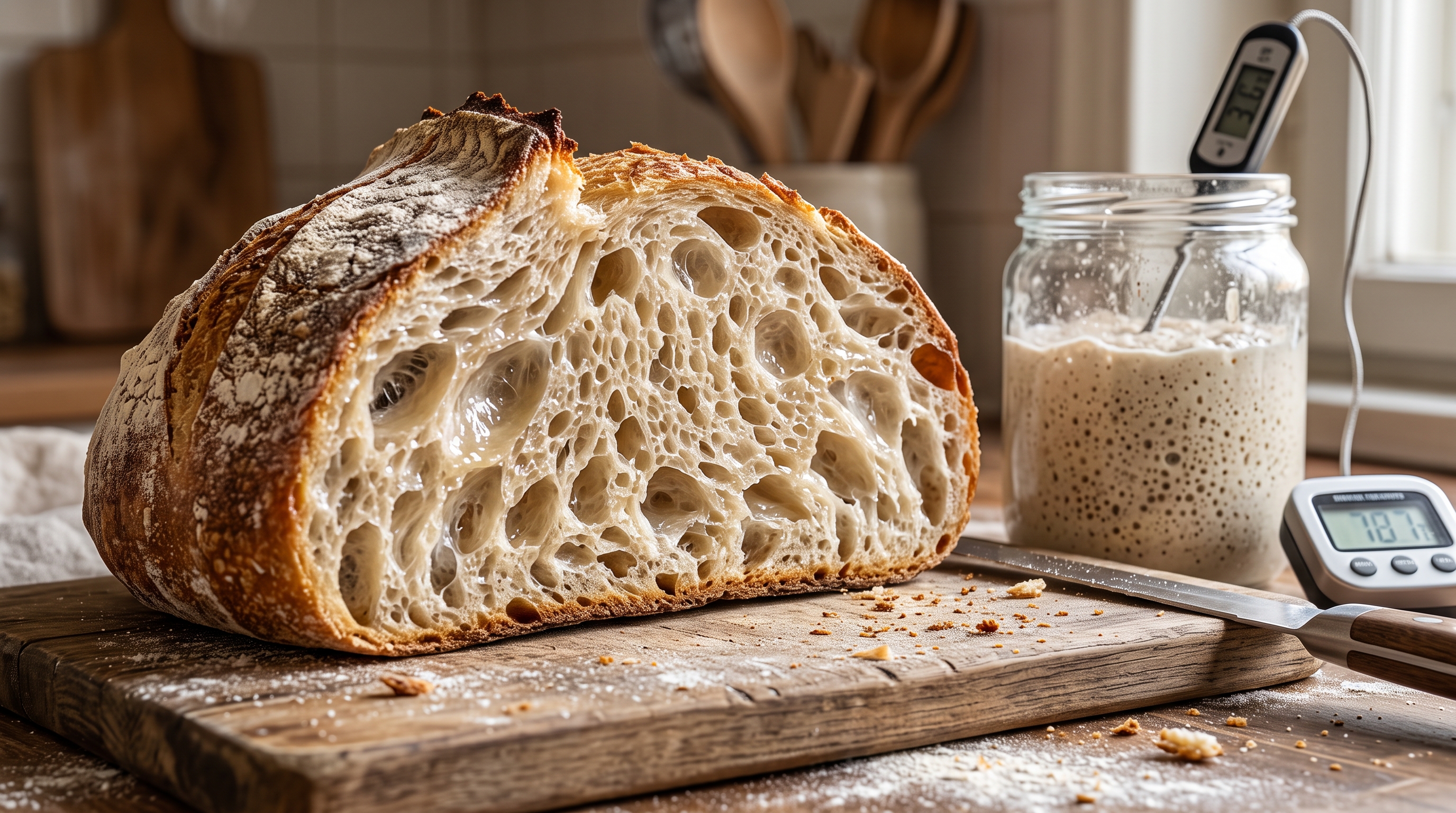
If you've ever baked sourdough and wondered why some loaves taste bright and yogurty while others lean sharp and vinegary, you've stumbled onto one of the most useful levers in fermentation: the lactic-to-acetic acid ratio.
Your starter's bacteria produce both lactic acid and acetic acid. How much of each ends up in your dough shapes the entire flavor profile of your bread. And you can steer that ratio with a few simple changes, even on your first bake.
This guide covers what the ratio means, how temperature shifts it, and how to use basic tools (a probe thermometer and a stable fermentation jar) to dial in the sourness you actually want.
Understanding the lactic-to-acetic ratio
Your sourdough starter is home to lactic acid bacteria, or LAB. Different strains of LAB produce different acids depending on conditions:
- Lactic acid brings smooth, creamy, yogurt-like sourness. It also encourages open, glossy crumb structure.
- Acetic acid brings sharp, vinegary, punchy sourness. In large amounts it can tighten the crumb slightly.
Both acids occur naturally in every sourdough. The ratio between them determines whether your loaf tastes gentle and mild, bold and tangy, or somewhere in between.
The single biggest factor that shifts this ratio? Temperature.
Temperature as a steering wheel
Here's the core rule:
Warm fermentation = more lactic acid (mild sourness).
Cool fermentation = more acetic acid (sharp sourness).
Everything else in this article builds on that one idea.
Warm fermentation (24 to 28 °C): creamy, mild, yogurt-like sourness
If you want a loaf with gentle tang, soft acidity, a sweet buttery aroma, and an open airy crumb, warm fermentation will get you there.
Why warm temperatures favor lactic acid
LAB strains that produce lactic acid multiply faster in warmth. They consume sugars quickly, and the resulting acid is round and mellow. This is the flavor profile most people associate with a French country loaf, the kind that pairs well with butter, jam, or soft cheese.
How to keep fermentation warm
A few practical options:
- A fermentation heating wrap set to your target temperature. This is the most reliable method because it holds a consistent temperature regardless of room conditions.
- A warm corner of your kitchen (near an oven that's been on, or on top of a fridge).
- An insulated container. A sourdough starter jar with thick walls holds temperature better than a thin glass jar.
Use a digital probe thermometer to check your starter temperature directly rather than guessing from the room temperature. Starter temperature and room temperature can differ by several degrees.
Cool fermentation (18 to 22 °C): sharp, vinegary, bold sourness
If you prefer punchy tang, deep sour notes, and a more assertive flavor, cooler fermentation is the approach.
Why cool temperatures favor acetic acid
At lower temperatures, the LAB strains that produce acetic acid have more time to work. The slower fermentation gives them an edge, and the resulting flavor has that classic San Francisco sourdough character: sharp, complex, and unapologetic.
How to keep fermentation cool
- Ferment in a cool room or basement.
- Use a wine fridge set to 18 to 20 °C.
- Place your starter near a cooler part of the house.
Again, verify with a thermometer. "Cool" is subjective; 18 °C and 22 °C will give you noticeably different results.
Cool-fermented loaves stand up well to strong flavors: aged cheese, cured meats, hearty stews.
Starter feeding ratios also influence sourness
Temperature is the main lever, but how you feed your starter matters too.
For milder sourness:
- Feed more frequently (every 8 to 12 hours)
- Use higher hydration (100% or more, meaning equal parts flour and water by weight)
- Keep the starter warm
For stronger sourness:
- Feed less frequently (every 18 to 24 hours)
- Use lower hydration (60 to 70%, meaning more flour than water)
- Keep the starter cool
Why does hydration matter? A stiffer, lower-hydration starter traps less oxygen, and that oxygen-poor environment favors acetic acid production.
Weighing your feeds precisely makes a real difference here. A kitchen scale that reads to the gram takes the guesswork out of ratios like 1:2:2 or 1:1:1 (starter:flour:water by weight).
How temperature affects crumb structure
This is where the practical payoff shows up in your sliced loaf.
Warm fermentation tends to produce open, glossy, honeycomb crumb. Lactic acid encourages smoother gluten development, and the dough rises more evenly. If an open crumb is your goal, warm fermentation plus high hydration is the combination to try.
Cool fermentation tends to produce a slightly tighter crumb. Acetic acid can stiffen gluten somewhat, leading to a denser (but still beautiful) interior. Many bakers actually prefer this for sandwich loaves because the slices hold together better.
A step-by-step method for beginners
You can start this today with your existing starter.
1. Check your starter temperature
Use a digital probe thermometer and aim for:
- Mild sourness target: 25 to 28 °C
- Sharp sourness target: 18 to 22 °C
2. Feed your starter accordingly
For mild sourness:
- 1:2:2 or 1:3:3 feeding ratio (starter:flour:water)
- 100% hydration
- Feed every 8 to 12 hours
For sharp sourness:
- 1:1:1 or 1:2:1 feeding ratio
- 60 to 70% hydration
- Feed every 18 to 24 hours
3. Bulk ferment at your target temperature
- Mild sourness: 24 to 26 °C for 3 to 5 hours
- Sharp sourness: 20 to 22 °C for 5 to 8 hours
Watch the dough rather than the clock. You're looking for a 50 to 75% rise with a domed, jiggly surface.
4. Cold retard (optional but useful)
Putting your shaped dough in the fridge always increases acetic acid slightly. Use this to your advantage:
- For mild sourness, keep the retard short: 6 to 10 hours
- For sharp sourness, extend it: 12 to 24 hours
A cold retard also makes the dough easier to score and handle, so most bakers use one regardless of flavor goals.
Once you've shaped and retarded, a proofing basket holds the dough's shape during that fridge rest.
You can also use pH test strips to check your starter's acidity before mixing your dough. A starter around pH 3.5 to 4.0 is at peak activity. Over time you'll learn to read the bubbles and smell, but strips give you a number to correlate with what you're tasting in the finished loaf.
Putting it together
Temperature control turns sourdough from a guessing game into a repeatable process. Warm fermentation for gentle, creamy acidity. Cool fermentation for sharp, bold tang. A thermometer, a reliable starter jar, and a kitchen scale are the three tools that make the difference between bread that happens to you and bread you meant to bake.
As an Amazon Associate, I earn from qualifying purchases. Product links on this page may earn Culture & Crumb a small commission at no extra cost to you.