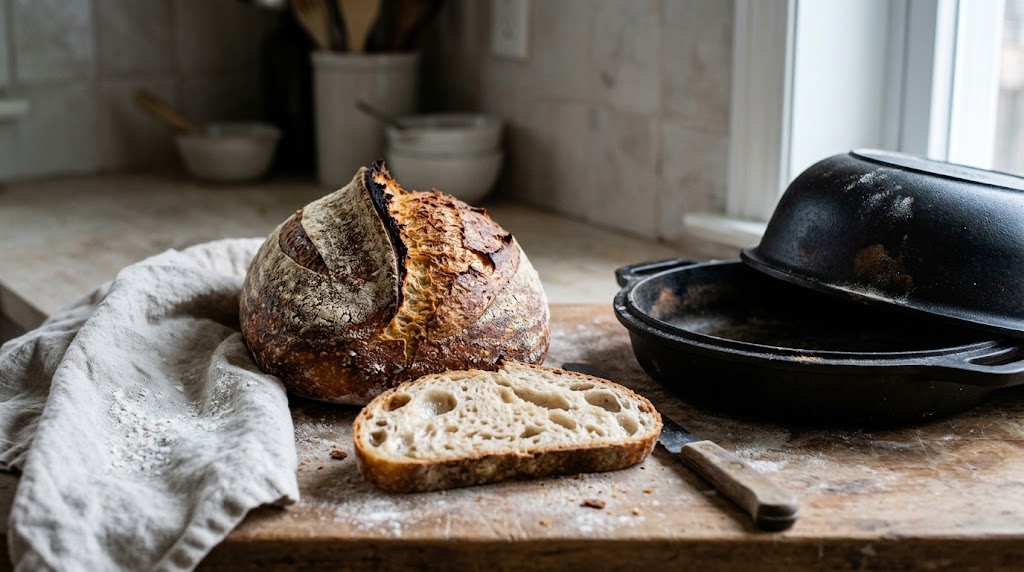
My kitchen stops looking like a kitchen during a sourdough bake. Flour on the counter, a cooling rack on the windowsill, the scale still on, and a banneton drying upside-down on the dish rack. None of this arrived at once. It accumulated over months, one tool at a time, usually because I hit a problem the last bake could not solve without it.
That is the honest shape of building a sourdough kit: you do not need everything on day one, and buying everything on day one does not make the bread better. A few tools matter immediately. Some earn their spot after your first handful of bakes. And some sit in a drawer until you wonder why you bought them.
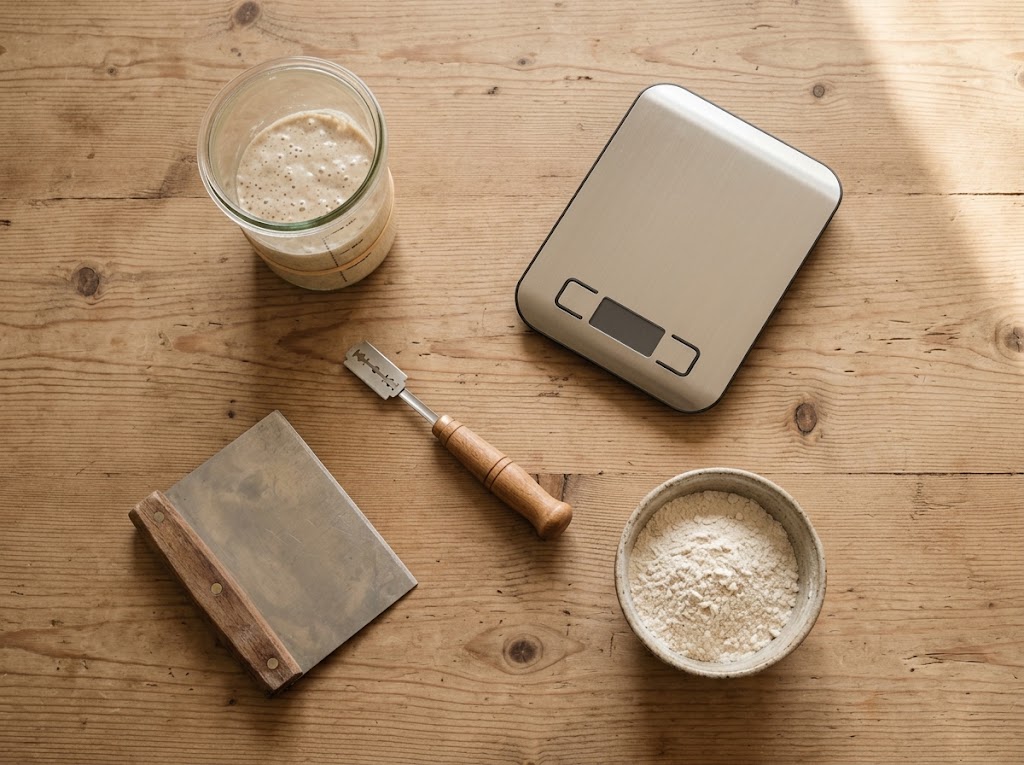
This post walks through what actually helps, in what order, with links to the products already researched in the sourdough & bread tools guide.
The tools that earn their place on bake one
A kitchen scale
Sourdough recipes live and die on ratios: flour to water, flour to salt, starter to dough. By weight, those ratios are repeatable. By cups, they drift every time.
You do not need a lab-grade scale. You need something that reads in grams, tares reliably, and does not auto-off while you are slowly adding water. The Etekcity food scale on the site is the kind of workhorse that sits on the counter and does its job for years without drama.
A starter jar
Your sourdough starter is a living culture that you feed regularly. It needs a container that lets you see activity (rise, bubbles, collapse) without opening the lid every time. A clear jar with a wide mouth for easy feeding and a loose lid for gas escape is the standard.
The sourdough starter jar in the guide has measurement markings on the side, which is the one feature that actually matters beyond "it holds flour and water." You can track rise percentage without a rubber band or a dry-erase marker.
A bench scraper
A stiff metal bench scraper does three jobs: it divides dough, it lifts sticky dough off the counter, and it cleans the work surface afterward. For a tool that costs a few pounds, it is used more than anything else in my kitchen on bake day.
The bench scraper featured in the guide is a simple stainless-steel rectangle with a comfortable grip. Nothing fancy, but you will reach for it every bake.
A proofing basket (banneton)
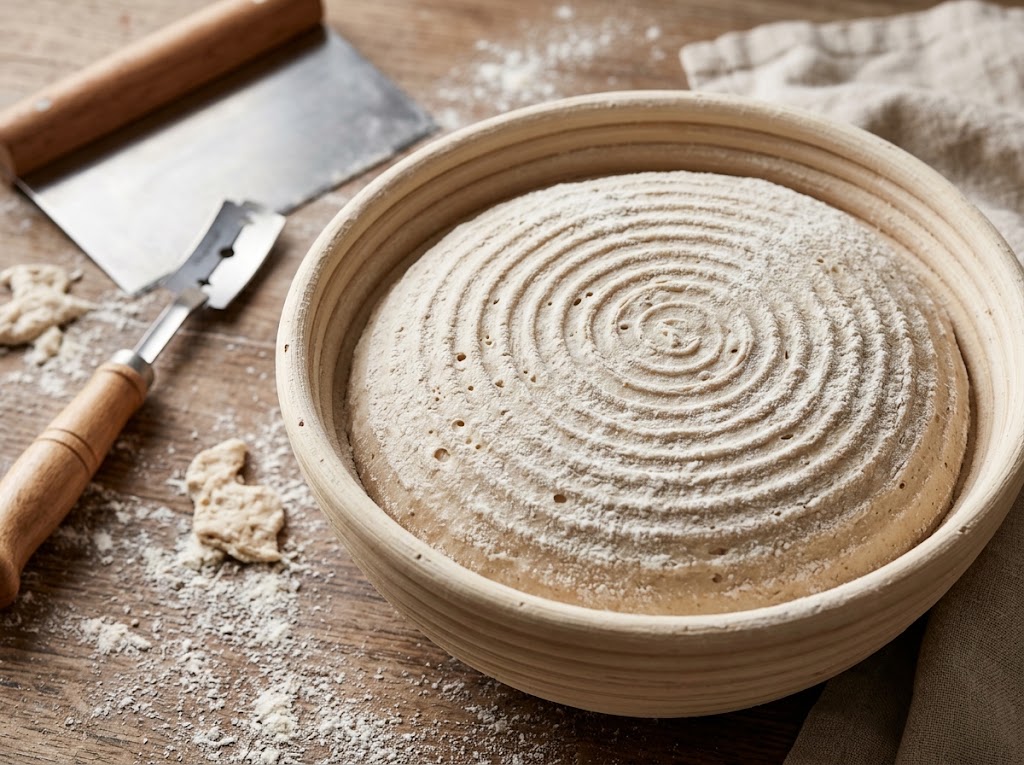
After shaping, sourdough needs support during its final rise. A banneton holds the shape, absorbs surface moisture, and gives the crust those ring patterns that people either love or pretend not to care about.
You can use a bowl lined with a floured tea towel as a substitute, and that works well enough early on. But a proper banneton does the job more consistently, especially in a cold retard overnight in the fridge where the dough is sitting for 12 to 18 hours.
The proofing basket in the guide is rattan, the traditional material. Rattan wicks moisture better than plastic and creates cleaner ring marks, but it needs to dry fully between uses or it will eventually grow mold.
A Dutch oven or covered baker
The oven spring that makes sourdough look like sourdough (the ear, the rise, the shatter-crisp crust) happens because of steam in the first 15 to 20 minutes of baking. A Dutch oven traps the steam the dough itself releases, creating a miniature steam chamber without spraying water into your oven.
If you already own a heavy Dutch oven, you have this covered. If you do not, a Lodge cast-iron combo cooker works well and doubles as a skillet. The shallow side becomes the base, making it easier to load the dough without burning your forearms.
Tools that earn their place after a few bakes
A lame (scoring blade)
Scoring is functional first, decorative second. The cut controls where the loaf expands in the oven. A razor blade on a stick (that is essentially what a lame is) gives a cleaner, more controlled score than a kitchen knife because the curve of the blade creates an ear when angled correctly.
The bread lame researched in the guide holds standard safety-razor blades, which are cheap to replace. Change the blade regularly; a dull lame drags the dough instead of cutting it.
An instant-read thermometer
Water temperature controls fermentation speed. Dough temperature at mix determines how fast the bulk ferment moves. Internal bread temperature tells you when the loaf is done. A single instant-read thermometer covers all three checks.
This is one of those tools that feels optional until you realize why your last two bakes were so different from each other despite using the same recipe. The answer was almost certainly temperature.
What I would skip early
Some tools get recommended heavily but do not solve problems most beginners actually have:
- Bread-specific baking stones: A Dutch oven already provides the enclosed baking environment. A stone adds radiant heat from below, but the difference matters more when you are baking open (no lid) or doing pizza. For lidded sourdough baking, the Dutch oven is the stone.
- Dough whisks (Danish whisks): These are pleasant to use for mixing starter, but a fork or a spoon does the same job. It is a convenience, not a necessity.
- Couche cloths: Useful for baguettes and bâtards, but most home sourdough bakers start with round boules that go in bannetons. Buy a couche when you start shaping long loaves.
None of these are bad products. They solve real problems. They just solve problems you probably do not have yet on bake one through five.
Building the kit in order
If I were handing a list to someone starting tomorrow:
- Kitchen scale and starter jar (you need both before your first feed)
- Bench scraper (before your first shaping session)
- Dutch oven or combo cooker (before your first bake)
- Banneton (before your second or third bake, after you realize a towel-lined bowl is fiddly)
- Lame and thermometer (after your first few bakes, once you are chasing consistency)
That sequence mirrors how problems actually appear in practice. You do not need a lame until you notice scoring matters. You do not need a thermometer until you notice that two identical recipes gave different results.
Full product cards, ASINs, current Amazon links, and community-noted downsides for every tool mentioned here are in the sourdough & bread tools guide. For more on how we research and shortlist products, see our methodology.
Quick product links
- Etekcity Food Kitchen Scale — gram-accurate, reliable tare
- Sourdough Starter Jar with Markings — track rise without guessing
- Bench Scraper (Stainless Steel) — divide, lift, clean
- Rattan Proofing Basket (Banneton) — shape support + ring marks
- Lodge Cast-Iron Combo Cooker — steam chamber for oven spring
- Bread Lame (Scoring Blade) — clean scores, replaceable blades
Practical takeaways
- Scale + starter jar + bench scraper: the non-negotiable trio
- A Dutch oven provides the steam chamber most recipes assume you have
- A banneton earns its place fast, but a towel-lined bowl works for early bakes
- A lame and thermometer come after you start chasing consistency
- Skip bread stones, dough whisks, and couche cloths until you have a specific reason to buy them
FAQ
Can I bake sourdough without a Dutch oven?
Yes. Some bakers use a baking stone with a steam tray, or an inverted roasting pan as a lid. Results vary. A Dutch oven is the most reliable home method for trapped steam.
Does the banneton size matter?
Match it to your dough weight. A 9-inch round banneton fits roughly 500g to 800g of dough. Undersized baskets overflow; oversized ones let the dough spread flat.
How often should I replace the lame blade?
Every 5 to 10 bakes, or whenever scoring starts dragging instead of slicing. Blades are cheap; a dull one makes scoring frustrating and tears the dough surface.
Do I need a proofing box?
Not for most home bakers. An oven with the light on, a microwave with a cup of hot water, or just a warm corner of the kitchen works. A proofing box solves consistency in cold environments, but it is not a day-one purchase.
As an Amazon Associate, I earn from qualifying purchases. Product links on this page may earn Culture & Crumb a small commission at no extra cost to you.